













|
part 6: Alvaro Espinoza—biodynamics in the new world
It’s clear from the outset that Alvaro Espinoza isn’t
your average Chilean winemaker. ‘Traditional viticulture
artificializes the vineyards, creating an artificial medium’, says
Alvaro. ‘the result is that the wines are similar to those from
other places’. His view is very much that organics and biodynamics
facilitates the expression of ‘terroir’ (site-specific flavours
in wine), which isn’t a word you hear very often in Chile. He also eschews the besetting varietalism that has become
an enduring facet of new world winemaking. ‘I am not aiming to
make another Cabernet Sauvignon from Chile. Blending can add
character; that is why we are planting a whole range of
varieties.’ This sounds promising. So what is the story behind VOE? Initially, one of the
owners of Santa Emiliana was interested in integrated pest
management (IPM), a scientific approach to reducing chemical inputs
by targeting interventions just where they are needed. From here,
they progressed to organics in 1998 when plots from three farms were
selected as an experiment. Then, in 2000 Alvaro Espinoza was hired
to be responsible for this project. Alvaro had previously worked for 8 years at Carmen. He
first became interested in organic viticulture in the mid 1990s
through links with Fetzer – a Californian winery who pioneered
organics in the USA. He decided that conventional viticulture had
some severe limitations. ‘I’d lost my idealism and my connection
with the vineyards’, he explained. Through 1995 he had lots of
contact with the Fetzer and Bonterra team, and started to do some
work with Carmen later that year, putting some of their Maipo plots
into organics. In 1998 Alvaro had a sabbatical that proved to be very
significant: he went to Mendocino in California and spent 6 months
working on viticulture with the Mexican vineyard workers at
Bonterra. While he was there he had lots of contact with the Fetzers
and Alan York, a well known Californian biodynamic consultant. Alan
York gave him Rudolf Steiner’s book, which ‘changed my views
about nature’, he says. ‘Steiner’s views seemed very
logical’, and Alvaro’s return to Chile, with its environmentally
unfriendly industrial-scale viticulture, proved to be a big shock.
He left Carmen in 2000 to work for VOE. At VOE, three farms
were put completely into organics and biodynamics, and they are
being treated as closed units of production. There are three main
pillars to the vineyard work. First, they aim to increase the
biodiversity of the farms, with cover cropping and biological
corridors. ‘Monoculture helps to develop pests’, says Alvaro.
Second, there is composting: adding fertility to soil and preserving
healthy plants with natural nutrients. Finally, there is alternative
pest management work with compost teas, and biological products such
as Bacillus subtilis and Trichoderma (a fungus that
has antibotrytis and antioidium action). Alvaro is leaving an
increasing amount of flowers in the vineyards to encourage insects.
This has the side-effect of making the vineyards look pretty! Currently VOE are just using selected plots from their
farms for their wines. They have lots of new plantings, and they
sell off many of the grapes from the youngest vines. The whites
aren’t ready yet. The move to biodynamics has proven to be a complicated
process. ‘In 2000 we started to be in contact with Demeter’,
says Alvaro. In Chile there is no biodynamic association, so Alvaro
has had to make all the biodynamic
preparations preparations himself, a challenging task.
Initially, he had a problem getting yarrow, which isn’t native to
the wine growing regions of Chile. More complicated was getting the
bladders of red deer, used to ferment some preparations: there
aren’t any red deer in Chile. ‘Now we have enough to sell to
others’, Alvaro says. ‘For me the main view is the sustainable
view of the farm, seeing it as an organism’. With this goal in
mind, he’s bringing animals to the farms to close the cycle of
nutrients, so he can producing his own manure and compost. Recycling
is important and for their cover crops, VOE collect the seed and
re-use it. Currently the wines of VOE are classified as organic, but the plan is to proceed with biodynamic certification. This natural philosophy extends to the winery, which aims
to respect the landscape using raw materials such as wood, stone,
copper and adobe. Everything is gravity fed, and the small
fermenting tanks mean that Alvaro can work with small blocks. He
doesn’t use natural yeasts yet because this is too risky, but
he’d like to – at the moment he’s afraid of stuck
fermentations because of high potential alcohol levels. The wines? They’re pretty good. While I might have
expected them to show more ‘terroir’ characters, the structure
and concentration set them apart from many of their peers.
Impressive work, and I look forward to seeing what happens here as
the vineyards develop and come on line. Other topics in this series
|

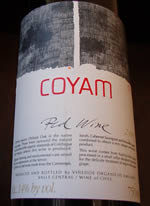 For
a Chilean winery, Viñedos Organicos Emiliana is unusual. It
is dedicated to producing environmentally responsible wines,
initially organically, but then the goal is for it to adopt
biodynamics. The man at the helm of the project, which started in
2000 with the backing of parent company Vina Santa Emiliana, is
Alvaro Espinoza, formely winemaker with Carmen. Alvaro is a true
pioneer, and has been single-handedly responsible for introducing
biodynamic viticulture into South America. Santa Emiliana selected
three farms in the regions of Maipo, Casablanca and Colchagua,
totalling a substantial 240 ha, to form the basis of this project,
so it is a serious commercial operation and not just a token
green-friendly PR gesture. I met with Alvaro at Ransome’s Dock
restaurant in London to hear about this new project, listen to his
views on biodynamics, and to taste the wines.
For
a Chilean winery, Viñedos Organicos Emiliana is unusual. It
is dedicated to producing environmentally responsible wines,
initially organically, but then the goal is for it to adopt
biodynamics. The man at the helm of the project, which started in
2000 with the backing of parent company Vina Santa Emiliana, is
Alvaro Espinoza, formely winemaker with Carmen. Alvaro is a true
pioneer, and has been single-handedly responsible for introducing
biodynamic viticulture into South America. Santa Emiliana selected
three farms in the regions of Maipo, Casablanca and Colchagua,
totalling a substantial 240 ha, to form the basis of this project,
so it is a serious commercial operation and not just a token
green-friendly PR gesture. I met with Alvaro at Ransome’s Dock
restaurant in London to hear about this new project, listen to his
views on biodynamics, and to taste the wines.