












|
part 7: biodynamics in action - a visit with James Millton
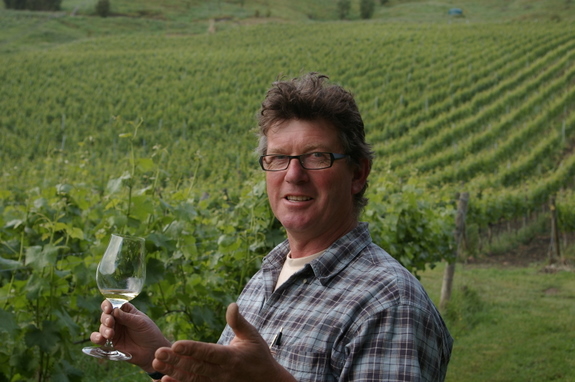
James Millton (above) is well known as one of
the leading ‘new world’ proponents of biodynamics. This is the
agricultural system that’s effectively a supercharged version of
organics, with some extra stuff thrown in. [More on that later.]
When I was planning my trip to New Zealand, he was always high up on
my list of who to visit. I’m fascinated by biodynamic wine
growers, not necessarily because I agree with all the theory behind
what they do, but because they just seem to make more interesting
wines.
Gisborne is a slightly anonymous region. It’s quite
damp, and not known as a fine wine zone – instead, most of the
vineyards here are geared up for making large volumes for the big
boys. A lot of sparkling wine material comes from here. This is why
it’s especially remarkable that Millton makes such good wines,
using biodynamics, in a place where you’d expect the disease
pressure to be high, and one that’s not known for top wines. ‘We
take lots of risks by not using herbicide and fungicide’, says
James Millton.
Some
background on The Millton Vineyards. ‘I’ve been doing
biodynamics now for 23 years’, says James, who started the Millton
Vineyard in 1984, when he was 28. His wife Annie’s father had
developed vineyards on his Opou estate in Gisborne, and so when
James and Annie decided they wanted to establish their own winery,
this was the obvious place to start. It’s fascinating that
they’ve managed to make such interesting wines from a region that
no one thinks much of. ‘Gisborne, with its clay soils, is
acknowledged as making wines with full, fat fruit’, says James,
‘but I’m looking for minerality’. He’s surprised that
there’s so little interest in Gisborne on the part of other New
Zealand winemakers. ‘I’m confused about why people don’t want
to lean over the fence and have a look’, he says. But there’s
lots of interest from outside New Zealand, with people from all over
the world coming to Millton to see what is going on.
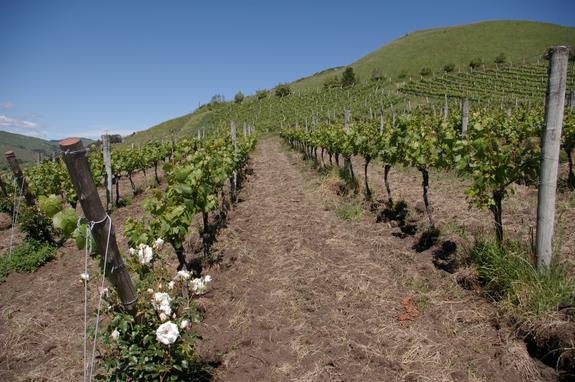
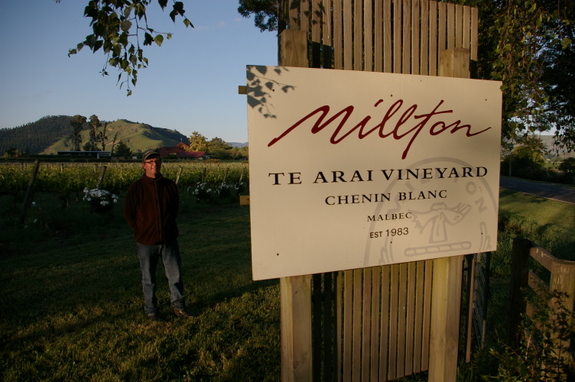
The estate now consists of four different vineyards in the Gisborne region, which James describes as ‘consistently inconsistent’. ‘We get vintage variation’, he adds, ‘and I think that’s good thing’. Opou, a 7.7 hectare vineyard, was planted in 1969, and then replanted in 1983. Young vines are being interplanted with old, and the idea is that if a row of new vines is planted between the old then the spacing will be better – originally it was 3 m × 1.8 m (2500 vines hectare), and the goal is to get it to 1.5 × 1 m (6000 vines/hectare). Te Arai vineyard is near this: it’s 2.8 hectares, and within it are two ‘clos’, named Samuel (Viognier) and Monique (Chenin) after James and Annies’ kids. Riverpoint is a 6.8 hectare vineyard growing Chardonnay and Viognier, while the jewel in the crown for Millton is the spectacular Naboth’s Vineyard, a steep hillside vineyard first producing in 1993. This site has been developed to include five different parcels, which together make up the Clos de Ste. Anne estate. Altogether there are now 30 acres here (approximatel 15 hectares), which takes the total Millton Vineyard holdings to about 30 hectares.
A short video of the Clos Ste Anne vineyards
What
about biodynamics? To someone with a scientific mind, this
increasingly popular form of winegrowing looks a bit strange. There
are the usual organic principles: no herbicides, no pesticides
(although copper and sulphur are allowed as ‘natural’
fungicides) and no inorganic fertilizers, but in addition a range of
special preparations are used, and then either sprayed on the vines
or added to the compost heaps that are an important aspect of this
way of farming. In some cases these preparations are used at
homeopathic dilutions; in all cases they are ‘dynamized’ by
stirring in a particular way, and James has his own device for doing
this. These preparations are applied according to the timings set
out in the biodynamic calendar. The same calendar dictates when
certain jobs in the vineyard and winery are carried out. Of course,
there’s a bit more to biodynamic than a few sprays and organics:
it’s a philosophical system that growers tend to embrace, and
which then guides all their practice. I suppose the fundamental
principle is for farmers to work in a way that is sensitive to the
forces of life, and that encourages a healthy, living soil.
On
my visit, I got a glimpse of biodynamics in action. First, there
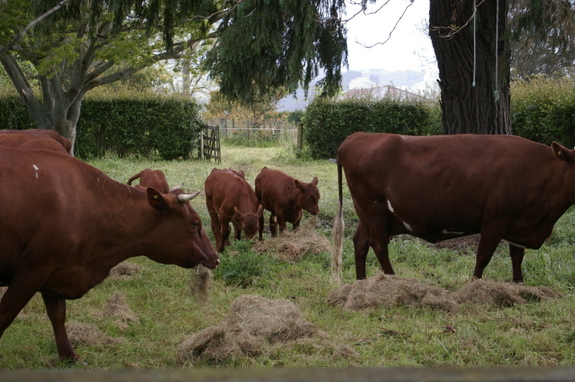
were the cows. Until a few years ago James used to collect manure
from a biodynamic farm. But then he decided to buy his own cows, and
bought six six-week old calves. He’s now had three lots of calves
with these cows, and they make his manure. James enjoys having the
herd. ‘They rationalize my feelings’, he says. ‘They know when
I’m cross and when I’m happy. Since they’ve been here the
whole vineyard has changed. It seems to have a spring warmth to it,
and the distraction they provide is quite positive’.
The
second glimpse was mixing and spraying one of the preparations,
BD501. This is a silica (ground quartz) preparation that is buried
in a cow’s horn, later dug up and then after mixing with water is
sprayed on the vines. To do this, we had to get up at 6 am after a
reasonably late night, but it was worth the effort. On a beautiful
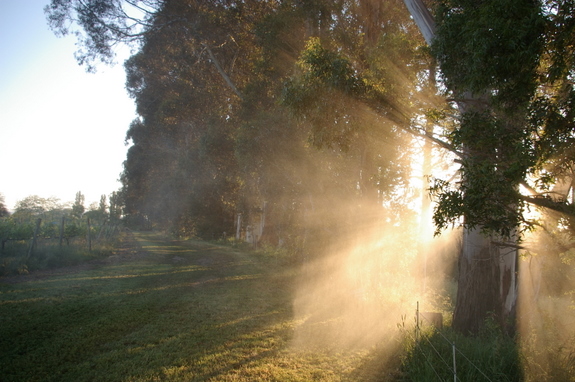
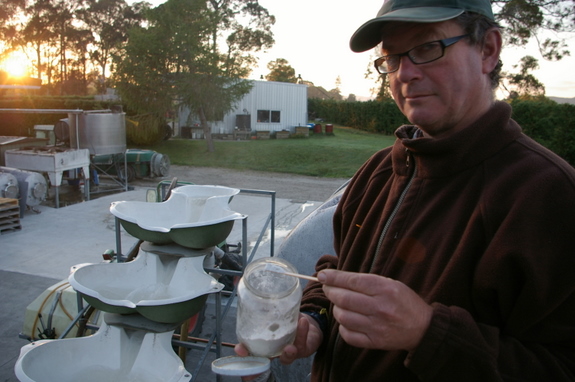
morning, with the sun poking through the trees, I watched James add
a small amount of the white powder preparation to a barrel of water
(above). The liquid was pumped through a Heath-Robinson-esque device
that stirred the mixture one way and then another as it flowed
through, thus ‘dynamizing’ BD501, making it ready for spraying
on the foiliage of the vines (see video below).
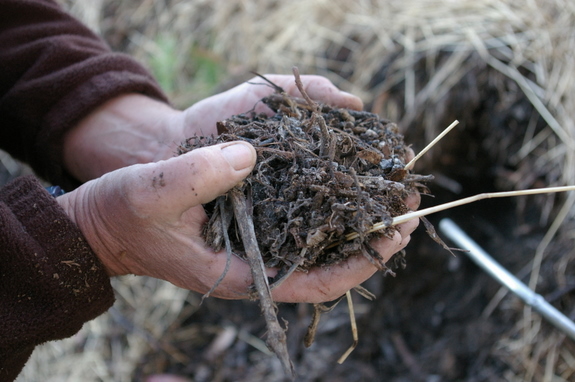
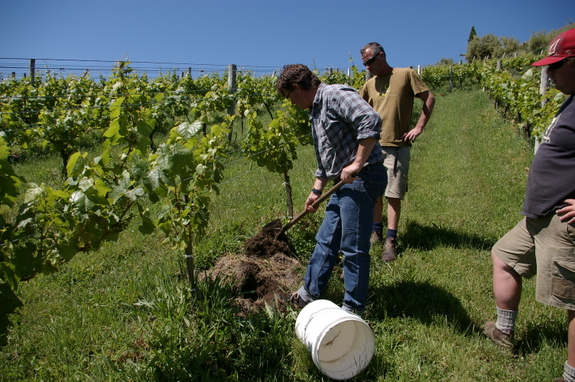
The third was the process of digging up cow’s horns, which we did later that morning. High up in Naboth’s vineyard, a few vines had been marked. James and his team dug, until they hit the cache of horns that had been buried here a few months earlier. Inside each of these horns was the preparation BD500. This is cow manure from lactating cows which is then placed in the horns for a subsoil sojourn. The resulting prep is a smooth clay-like paste that is then diluted and sprayed onto the vineyard soil, to encourage microbial growth. Other topics in this series
|