|
Austrian
wines
Part
2: Neckenmarkt
Winzenkeller Neckenmarkt, Harkauwerg 2, A-7311
Neckenmarkt, Austria
Website: www.neckenmarkt.at

My
Austrian journey begins rather unpredictably. Austria is known
best for its whites; in particular Grüner Veltliner
and Riesling from the Wachau and
its neighbouring regions the Kremstal and Kamptal. But we’re
beginning with Burgenland, which is red wine country, and the
Neckenmarkt 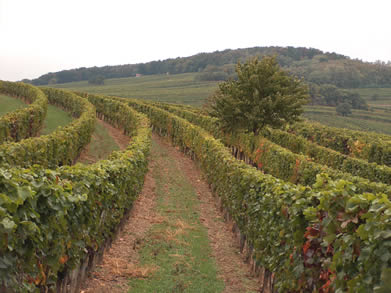 cooperative.
I guess it’s a good starting point: it stops us getting in a
rut, zoning in on just one region and style. It reminds us that
Austria is actually a reasonably diverse wine country; it makes
some serious reds as well as fabulous whites. cooperative.
I guess it’s a good starting point: it stops us getting in a
rut, zoning in on just one region and style. It reminds us that
Austria is actually a reasonably diverse wine country; it makes
some serious reds as well as fabulous whites.
Neckenmarkt is an old market town that until the late
middle ages gained great importance from being located on a trade
route stretching from the Baltic to the Mediterranean. Wine has
been made here for centuries, but the winemaking scene here
assumed its modern shape only after the phylloxera disaster in the
late 19th century, when vineyards were replanted with the sorts of
varieties seen today. These include the Blaufränkisch, the most
important grape of the region, which has its origins here.
The cooperative at Neckenmarkt was born under rather
difficult circumstances. Abundant harvests in 1966 (THE world cup
year) and 1967 (my birth year) resulted in a saturated marketplace
and in 1968 growers were being offered less than cost for their
grapes. The Mayor of Neckenmarkt, Karl Heincz, persuaded the
growers to form a cooperative. In 1968 243 growers joined, and
this has now risen to over 300, managing 300 hectares of
vineyards. Even the mathematically challenged will realize that
the average holding is quite small, and 90% of these growers
manage their vineyards on a part-time basis.
 |
 |
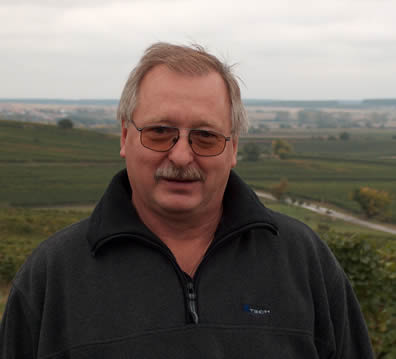
| Cellar master
Joseph Tesch |
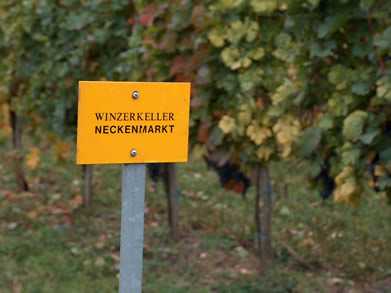
A sign
marking an '8-grapes' vineyard holding |
From 700 000 kilos of grapes in 1968, the co-op
processes 2–2.3 million kilos per year, which is about 1% of
Austria’s total harvest, and approximately 5% of all Austrian
reds. That’s because Neckenmarkt is primarily a red wine
operation, with just 2% of its production white.
How do you ensure quality winegrowing when you are
managing a coop? Neckenmarkt take two approaches. First, they have
two employees dedicated to helping out the growers. The growers
listen to their advice, because their payment depends on how
successful their work is. Second, the payment structure is
determined by the sugar ripeness of the grapes. Of course, this
would be barmy in the new world, but in classic old world wine
regions sugar ripeness is a good proxy for phenolic ripeness
(grapes generally only reach high sugar levels when they are
physiologically ripe in cooler climates). The figures depend on
the vintage, but in 2003 85 oeschle was the average, and they paid
73 c/kilo for this, 5% more for 86 oeschle, 10% more for 87
oeschle and so on. Typical yields are 8.5 Tonnes/hectare, down
from about 12 a decade ago.
In addition, there has been a novel ‘8-grape
program’, which involves about a tenth of the vineyards. Growers
signing up to this must have vines aged at least 25 years, ad in
the best locations. They agree to reduce yields to between 5 and 6
tons/hectare, for which they receive a supplement of more than
€7000.
Climate: Central Burgenland is located between the
Pannonian (continental, very dry) and Illyric (affected by lows
over the Adriatic sea, with more rain) climates. It has long
summers and lots of sunshine, which makes it good for red wines.
There is some climatic influence from the Neusidler lake. The
soils: more gravel and shale makes the wines delicate, lighter and
‘more playful’; more loess makes them fatter and richer.
The
wines
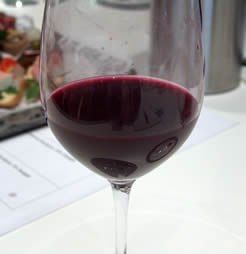 Zweigelt
2004 (just fermenting) Zweigelt
2004 (just fermenting)
Amazing vivid red/purple colour (see right). Harvested
at 90 oeschle on 1 October (tasted on 15th) and pressed on 12th
October. Very fresh and intense with bright vivid fruit and lovely
smooth tannins. Good concentration and very tasty. Zweigelt ripens
early.
Zweigelt Classic 2003
Very sweet, open berry and black fruits nose. The palate is
fresh and fruity with nice open, slightly sweet fruit and a nice
subtle spicy structure. Very smooth and quite elegant: a mellow
wine. Soft and compact, with a bit of structure: a lovely
accessible red. Just stainless steel used. Very good+ 89/100
Blaufränkisch Hochberg 2003
Appealing nose of brambly berry fruits with a spicy edge. The
palate is quite structured with nice chewy, spicy fruit and quite
a bit of tannin. A very savoury style: nice and chewy, a good food
wine. Just stainless steel used here. Very good+ 88/100
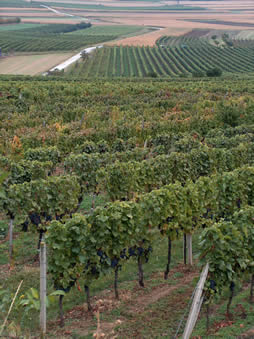 Blaufränkisch
Himmelsthron 2002 Blaufränkisch
Himmelsthron 2002
Dense colour. Quite an oaky nose with savoury vanilla and
chocolate notes accompanying the sweet fruit. The palate is chunky
and bold with lots of oak. Savoury and spicy: oak is a bit too
obvious for me. Very good 84/100
Via Romana 2002
A blend of 40% Blaufränkisch, 40% Cabernet Sauvignon and 20%
Zweigelt. Quite an intense, savoury nose with some spicy oak
overlay to the dark fruits. The palate is structured and savoury
with nice spicy tannins. A bold, rich style of wine with
noticeable oak, showing just a touch clumsily at the moment.
Dense, chewy and spicy. Very good+ 87/100
Porto Magica 2002
Mostly Blaufränkisch with a touch of Cabernet and Zweigelt,
this flagship wine is named ‘magic potion’. It has a forward,
sweet dense nose with vanilla, spice, hints of tar and some ripe
dark fruits. The palate is complex and dense with taut spicy berry
and black fruits and a fair bit of oak influence. Good potential
for ageing, and as this has only been bottled recently I’d take
my rating as provisional. Very good+ 88/100
wines
tasted 10/04
Back
to top
|