
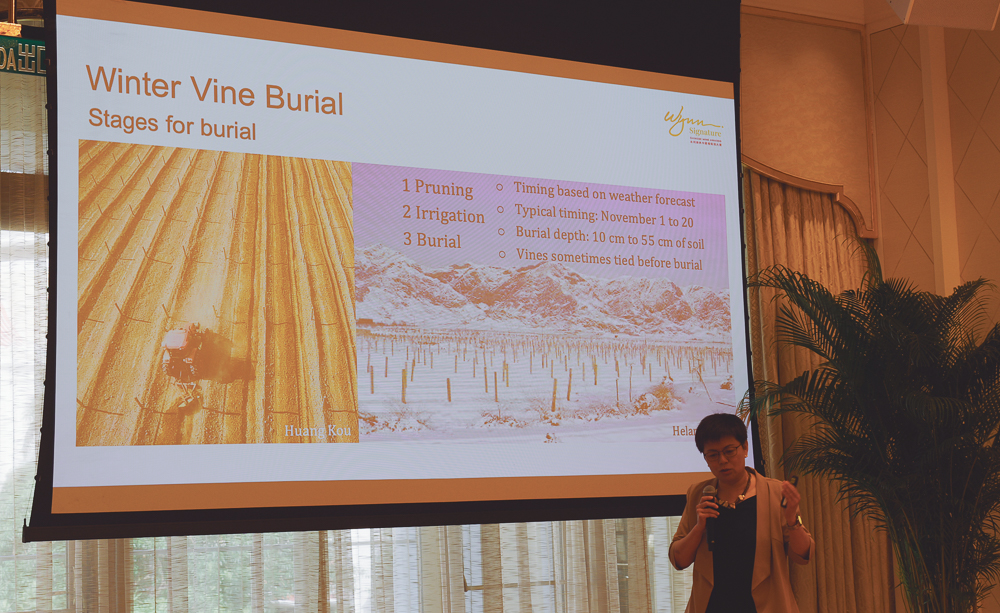
Winter Vine Burial in China, a seminar from Professor Huiqin Ma, China Agricultural University
Huiquin Ma presented a seminar on vine burial to the judges at the Wynn Signature Chinese Wine Awards in Macau. She says this is a very important issue in China because most of the wine regions have very cold winters, and Vitis vinifera doesn’t have good cold tolerance.
As soon as it begins to get cold and the vines approach dormancy, they are pruned. Typically this will be in October or early November. The soils in almost all Chinese regions are sandy or sandy loams, and before burying the vines they do an irrigation in preparation for burial. And then the vines are buried, with 10-55 cm of soil covering them.
They can’t be buried too early. It’s only when the temperature goes down and the respiration rate of the vines slows that you can bury them. But you can’t leave it too late, either, because the ground will be frozen. So this leaves quite a short window to do a lot of work. November 1-20 is the normal time, but some people do a pre-burial in October. Mechanization was vital in making the large vineyards viable, because of this small window for burying.
The burying depth depends on the temperature and wind. The vines need deeper burial if it is really cold or very windy.
Unearthing takes place late March to April. The vines need to be put back on the trellis, and they need another dose of irrigation. Unearth too soon and the buds break, spring frost is also an issue.
This isn’t a process that’s unique to vines in China, where soil has been used as insulation for other crops, such as cabbage, pomegranate and fig trees for a long time.
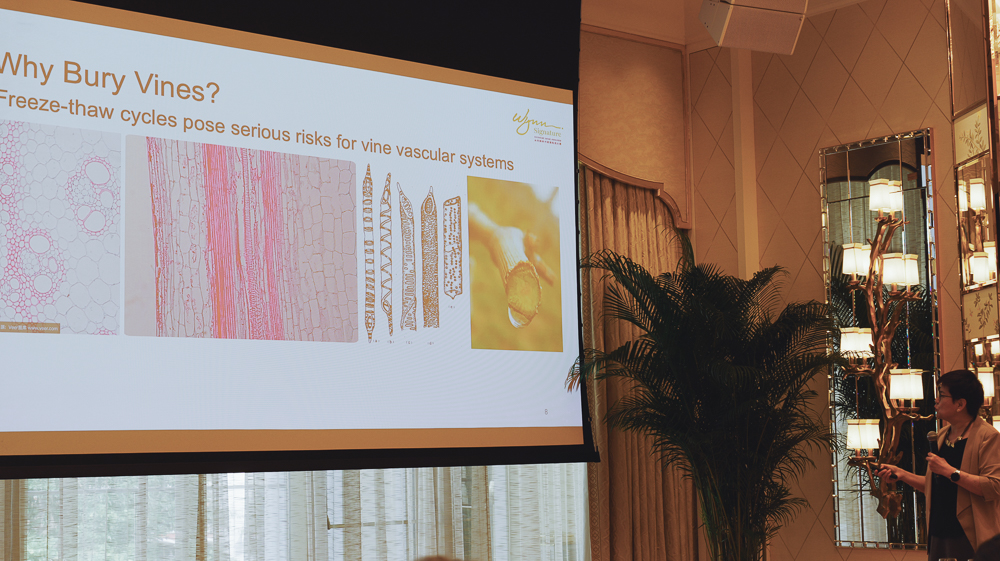
Mature canes and dormant buds of vinifera can survive air temperatures of -15 to -20 C. Typical vine roots survive at -5 to -8 C, and cold-resistant roots survive to -12 C. Freeze thaw cycles cause damage to the vascular system of the vine.
Here’s a video showing the process:
When vineyards are established where burial is needed, it’s necessary to remove all the stones. If they were left in the soil, they would damage the soil-moving equipment. Ma also mentioned grafting. Currently in China omega grafts are taking over, but they are not as strong as the traditional V-shaped hand grafting. This gives stronger graft unions which helps with burial.
The vines need to be grown in a shallow funnel, which makes the two flood irrigations (before burial and after unearthing) easier. Traditionally the vines were trained with long trunks. The longer the trunk, the more flexible it is for burial.
Here’s another film showing some of the burial practices:
In the last 30 years there has been a change in the way vines are trellised. In the 1980s people moved away from the more traditional pergola system (widely used for table grapes, of which far more are grown in China than wine grapes) towards a vertical canopy system. Another move was towards using a fan system with several shorter canes. This had the advantage of giving higher yields. A further innovation was to move to a vertical cordon system, with the fruit zone going vertically. The problem here is uneven ripening: the bunches at the top and bottom are of different maturity.
So they tried doing guyot with a 50 cm fruiting wire, and quickly the trunk became too thick for easy burial. Finally, in the last 20 years they’ve adopted a new system with diagonally growing trunks with a horizontal cordon attached, all of which can be pulled down and buried. This has really helped with grape quality. The row width changed from 2.5 m to 3.5 m for mechanization around 15 years ago, to allow bigger tractors for burying the vines more easily.
Just before the vines are buried they are tied together and covered with polythene to protect them when they are unearthed.
It’e estimated that in most regions in China, 25-30% of the cost of viticulture is the hilling over process, so it’s a major expense. The newer diagonal system gives lower yields because of the shorter fruit zone and wide spacing. They get around 7-15 tonnes per hectare whereas before they were getting 25 tons/hectare. This makes the grapes more expensive.
If you want a cover crop or even just grass cover, you must sow it each year because of the burial. This adds cost. Also, there is a strong north wind from Siberia in the winter, so there’s dust bowl potential. Because of this, some leave pruning debris on the vines over winter to stop the wind and prevent the soils blowing away. This debris is then removed in the spring. This creates another cost.
Hilling over also has an impact on microorganisms. The cold and the burying reduces the microorganism populations on the vine, which affects wild ferments. These can be very slow. The populations on the berries is less diverse and there are fewer microbes.
Breeding new cold hardy varieties is an interesting way of avoiding burial. In China they have been breeding hybrids with Vitis ameurensis, and varieties like Beihong and Beimei are being grown already. She says that there’s a long way to go here in terms of wine quality.
There are some other places where vines are buried. In Québec and Prince Edward County in Canada the winters are cold enough that vines are buried, or geotextiles are used to cover the vines. There, the fruiting wire is very low and the vines are pruned then covered over. There’s no need to bend the trunk. This wouldn’t work in Chinese regions because it rains quite a bit during the growing season and having the fruiting wire very low would be problematic. And geotextiles wouldn’t work: the winters are dry, and unlike Canada there’s rarely any snow covering them.
There’s a really good, in-depth scientific review of the subject here: https://www.researchgate.net/publication/373973956_Overwintering_covered_with_soil_or_avoiding_burial_of_wine_grapes_under_cold_stress_Chinese_wine_industry’s_past_and_future_challenges_and_opportunities/link/6505a6a60142892697218277/download?_tp=eyJjb250ZXh0Ijp7ImZpcnN0UGFnZSI6InNjaWVudGlmaWNDb250cmlidXRpb25zIiwicGFnZSI6InB1YmxpY2F0aW9uIn19